
Numerical Simulation and Multiphysics Modeling
Understand, predict and optimize complex systems using digital simulation
Digital simulation today constitutes an essential tool for designing, analyzing and optimizing industrial systems before their implementation.
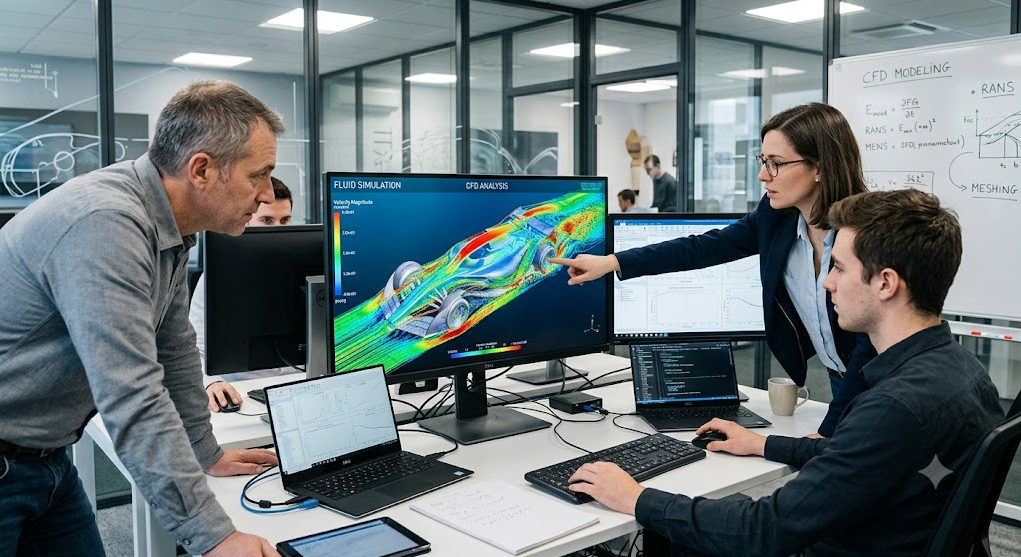
ZEnergy Consulting provides you with high-level expertise in computational fluid mechanics (CFD), heat transfer, multiphase flows and multiphysics modeling in order to resolve complex issues in the fields of energy, nuclear power, the environment and industrial processes.
Areas of expertise
Computational Fluid Mechanics (CFD)
Simulation of fluid flows in complex industrial systems:
- internal and external flows;
- ventilation and cooling;
- thermal transfers;
- atmospheric dispersion;
- turbulent, transient flows;
- multiphase flows.
Thermal Transfers
Analysis of the phenomena of:
- conduction;
- natural and forced convection;
- thermal radiation;
- thermal management of equipment;
- industrial cooling;
- furnaces and thermal processes.
Multiphysics Simulation
Coupling between different physical phenomena:
- thermal and fluid mechanics;
- multiphase flows;
- transient phenomena;
- fluid-structure interactions;
- complex industrial systems.
Expertise Based on Scientific Research
Doctor in computational fluid mechanics, his research focused on the study of natural convection, hydrodynamic instabilities and transition phenomena towards chaos by direct numerical simulation (DNS).
This work led to several international scientific publications in reference journals in fluid mechanics and physics.
This experience allows us to approach industrial projects with an in-depth understanding of physical models, their assumptions and their limits.
Development and Validation of CFD Codes
Unlike simply using commercial software, Dr. Zhenlan GAO has significant experience in the development, improvement and validation of scientific computing codes.

Participation in the development and validation of the open source CFD code Code_Saturne for micro-meteorology and environmental applications:
- dispersion of urban pollutants;
- dispersion of industrial pollutants;
- air quality studies;
- performance evaluation of wind farms.
Project of simulation of micro-meteorology in a district of Toulouse carried out in collaboration with EDF R&D, Météo-France and several research institutes.

Development and validation of multiphase compressible flow models in the EUROPLEXUS code for the analysis of accident scenarios in the nuclear field.
Tools and Skills
Simulation software




Scientific languages
- Fortran
- C
- Python
- OpenMP
- MPI
High Performance Computing (HPC)
Parallelization, code porting, performance of intensive computation on supercomputers proposed by:
- EDF (Top 500 worldwide)
- CNRS-IDRIS (Top 500 worldwide)
Industrial successes

Realization of a CFD simulation of a high temperature test bench intended for the qualification of aeronautical engine turbine blades, in order to analyze flows, combustion and heat transfers.
Result obtained: the heat flux distribution on the surface of ceramic blades was accurately predicted by numerical simulation and validated by comparison with experimental results.

Study by numerical simulation (ANSYS Fluent) of internal flows, particle transport and deposition phenomena in a storage tank intended for an industrial cleaning vehicle, using a discrete phase model (DPM).
Result obtained: Optimizing the geometry of the tank made it possible to reduce dead deposit zones and increase the operational efficiency of the equipment.

Study by numerical simulation (OpenFOAM) of the distribution of reactive gases in a low pressure carburizing furnace in order to optimize the homogeneity of the thermochemical treatment.
Result obtained: A new injection system configuration achieved the processing uniformity required by automotive customers, including General Motors and Ford, without an increase in gas flow or processing cycle time.

Process optimization of pressurized gas quenching by the introduction of the fractal grid, improving the efficiency of heat exchange by increasing the turbulent intensity.
Result obtained: without increasing the power of the quenching turbine, the characteristic cooling time was reduced from more than 20 seconds to less than 10 seconds, allowing the required surface hardness to be reliably achieved.

Study of the water hammer phenomenon in the primary circuit of a 4th generation reactor using one-dimensional numerical simulation (PIPNET).
Result obtained: Validation of an operational methodology for concrete cases, demonstrated by a simplified case study strictly respecting the confidentiality constraints of the project.
Added Value
The objective of a simulation is not only to produce images or numerical results.
A relevant simulation must allow:
- to understand physical phenomena;
- to identify the causes of a problem;
- to evaluate different solutions;
- reduce development costs;
- to limit experimental tests;
- to make technical decisions with confidence.
Thanks to dual experience in scientific research and industry, ZEnergy Consulting provides rigorous analyses,